
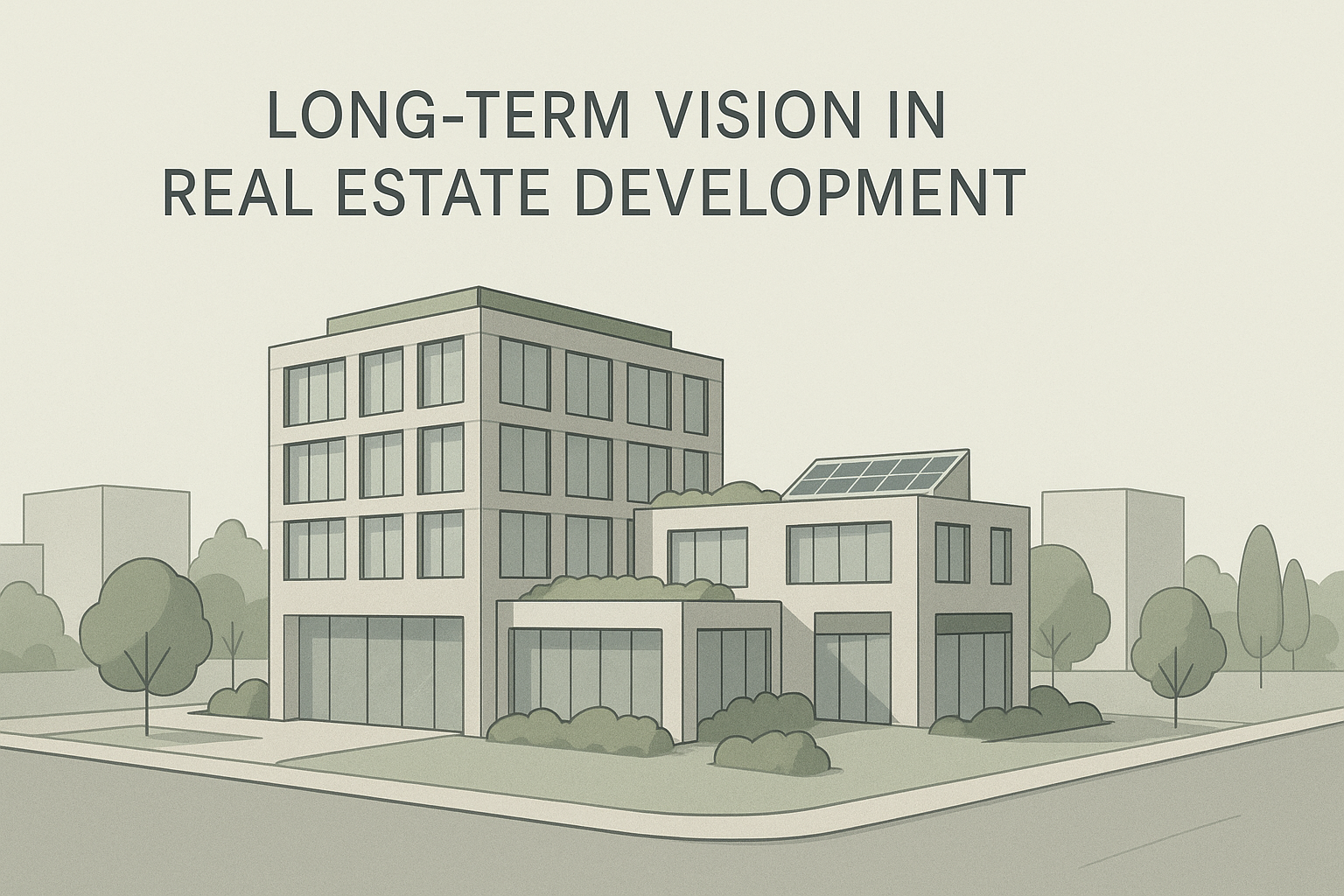
Real Estate Development Strategy: A Long-Term Framework for Commercial and Mixed-Use Value Creation
For business owners, investors, and corporate decision-makers, development decisions are rarely just about building new space. They are about timing, risk, capital allocation, regulatory feasibility, and the long-term performance of an asset within its market.
A clear real estate development strategy helps align these elements across the full lifecycle—from site identification and planning through delivery and ongoing management. It also supports consistent decision-making when market conditions shift, costs rise, or approval pathways become more complex.
This article outlines a practical, phase-based framework for evaluating and executing development, with an emphasis on commercial and mixed-use projects and the long-term ownership perspective.
What “Real Estate Development” Involves Today
Modern development is best understood as a coordinated lifecycle rather than a construction activity alone. It typically includes land or asset sourcing, planning and design, entitlement and permitting, financing, construction execution, and operations after handover.
MID Construction Group describes development as a “full lifecycle of activities,” emphasizing that a strategic approach ensures the right kind of development happens in the right location and time, balancing demand, costs, regulations, and community needs (MID Construction Group).
For long-term owners, this lifecycle view matters because early decisions (site selection, entitlement path, design flexibility) heavily influence later outcomes such as leasing resilience, capex requirements, and repositioning options.
Why Strategic Planning Is a Non-Negotiable in Commercial and Mixed-Use
Strategic planning connects the investment thesis to real-world constraints. Without it, projects can drift into common failure modes: overbuilding, underestimating costs, misjudging demand, or overlooking stakeholder expectations.
In commercial projects, planning should address demand drivers and competitive positioning. MID Construction Group notes that commercial development planning often involves analyzing foot traffic, demographics, and competitors; in residential contexts it may focus on amenities, commuting, and community factors (MID Construction Group).
Even when an asset is not retail-led, the principle generalizes: you need evidence-based assumptions about who will use the space, why they will choose it, and what alternatives exist.
Core components of a development planning framework
- Market analysis: demand, supply pipeline, tenant profiles, pricing power
- Site and micro-location fundamentals: access, visibility, transit links, surrounding uses
- Regulatory feasibility: zoning, height/density constraints, approval pathway, timelines
- Financial feasibility: capital stack, sensitivity tests, scenario planning
- Execution plan: procurement, phasing, risk controls, governance
Site Selection and Location: The Earliest Risk Filter
Site selection is often where value creation starts—or where risk becomes embedded. A site can be “cheap” for reasons that are expensive later: difficult access, permitting friction, environmental constraints, or a mismatch with demand.
According to MID Construction Group, site selection involves evaluating zoning laws, infrastructure access, environmental conditions, and proximity to target demographics. The wrong site can trigger cost overruns, delays, or weak market reception (MID Construction Group).
High Companies similarly emphasizes that strong opportunities require a multi-factor location and infrastructure assessment, including proximity to transportation hubs and awareness of planned infrastructure improvements that may affect long-term value (High Companies).
Practical implications for investors and occupiers
For investors, location quality directly affects leasing risk, exit liquidity, and the cost of capital. For occupiers, it affects workforce accessibility, logistics performance, and brand positioning.
A disciplined site selection process should therefore include not only today’s access and demand, but also a view of what the area is becoming (infrastructure plans, district evolution, competing supply).
Entitlement and Permitting: Where Strategy Meets Reality
Entitlement is the process of securing legal permission to build a specific use on a specific site. It can add substantial value when successful, but it can also extend timelines and create uncertainty if handled late or without local alignment.
MID Construction Group identifies land entitlement as one of the most critical phases, requiring coordination with government bodies and boards to ensure compliance. Poorly handled entitlements can delay or derail projects; successful entitlements can increase land value and unlock financing (MID Construction Group).
From a long-term real estate development strategy perspective, entitlement is not a box-ticking exercise. It is a risk-managed pathway that should be integrated into the investment model from day one, including time contingencies and alternative scenarios.
Financing and Financial Modeling: Aligning Capital With Phases
Development capital is typically drawn in stages: acquisition, pre-development, construction, stabilization. Each stage carries different risk characteristics and therefore different financing structures and pricing.
MID Construction Group notes that development often uses a mix of short-term construction loans and long-term mortgages, and that effective financial planning supports cash flow, unexpected costs, and stakeholder confidence (MID Construction Group).
High Companies also highlights the need to plan for delays and cost overruns and to identify funding sources early; without a solid financial plan, projects may not proceed (High Companies).
What decision-makers should look for in feasibility work
- Transparent assumptions (rents, vacancy, yields, absorption)
- Scenario and sensitivity analysis (interest rates, cost inflation, delays)
- Contingency planning that reflects execution and approval risk
- Alignment of lease strategy with financing milestones (e.g., pre-letting thresholds)
This is where a robust risk management in development approach becomes measurable: it shows up in conservative leverage, realistic timing, and resilient downside cases.
Phased Execution: Managing Complexity and Preserving Optionality
Large commercial and mixed-use projects often benefit from phased execution, whether due to infrastructure sequencing, leasing absorption, or capital pacing. A phased approach can reduce exposure to market timing risk and improve decision quality as new information emerges.
High Companies frames successful opportunity selection as combining market knowledge, strategic foresight, relationship-building, and risk management, with regular analysis and adaptation as conditions change (High Companies).
In practical terms, phasing can preserve optionality: it allows adjustments to unit mix, floorplate design, or amenity allocation if tenant needs evolve. It also supports governance discipline by creating defined decision gates.
From Handover to Operations: Protecting Long-Term Asset Value
For long-term owners, the “end” of construction is the beginning of operational performance. Asset durability, building systems reliability, and tenant experience are operational outcomes that trace back to development decisions.
MID Construction Group underscores that property and estate management preserve value through tenant relations, maintenance, budgeting, and compliance. Good management improves the user experience and helps keep assets profitable and well-maintained (MID Construction Group).
For commercial assets, this includes lease administration, common area planning, and service-level consistency. For mixed-use environments, it also includes managing interface points between uses so that the overall place functions effectively.
Long-term perspective: resilience over short-term optimization
A sustainable real estate development strategy prioritizes resilience: the ability to maintain occupancy, adapt space, and control lifecycle costs over years—not just achieve an initial delivery milestone.
That long-term view also reinforces why community fit and regulatory alignment matter. Projects that integrate smoothly into their context tend to face fewer operational constraints and repositioning barriers later.
Conclusion: A Disciplined Real Estate Development Strategy Supports Better Decisions
Commercial and mixed-use development rewards disciplined planning, not improvisation. A clear real estate development strategy connects market evidence, site fundamentals, entitlement feasibility, financing structure, and execution planning into a coherent decision framework.
For investors and business decision-makers, the practical takeaway is straightforward: evaluate projects across the full lifecycle. Prioritize sites that work operationally, model realistic scenarios, treat entitlement as a core value driver, and plan for long-term management from the outset.
In a market where timelines, costs, and tenant needs can shift quickly, a phase-based strategy is not only a way to manage risk—it is a way to protect long-term asset quality and performance.