
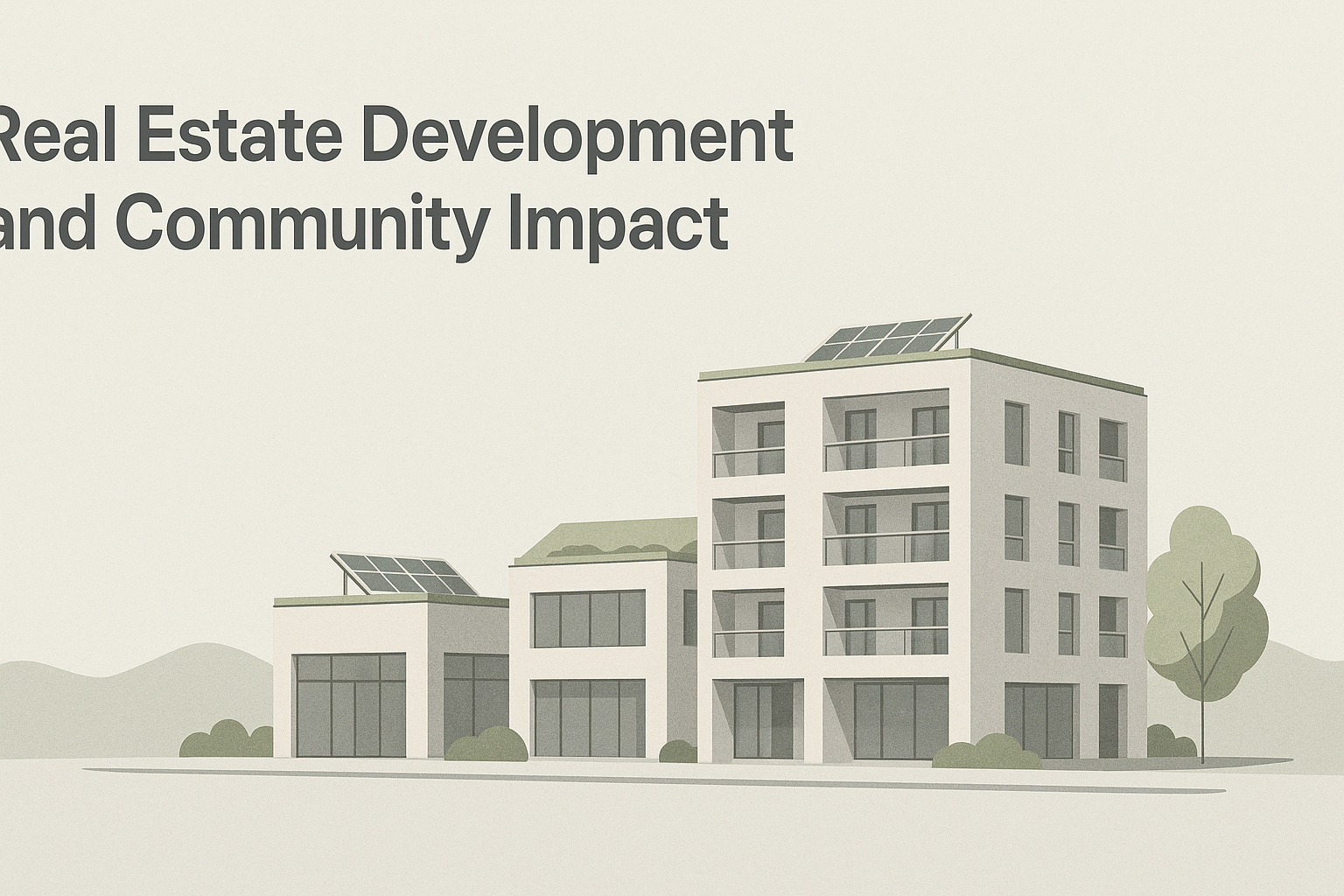
Real Estate Community Impact: How the Built Environment Creates Long-Term Value
For business owners, investors, and public stakeholders, the built environment is more than a backdrop for economic activity. Decisions about how properties are planned, built, and operated can influence local employment, access to services, mobility, and overall quality of life.
This is the core idea behind real estate community impact: using development and asset management choices to strengthen community well-being while maintaining financial discipline. In practice, this often includes prioritising public spaces, green infrastructure, and socially resilient mixed-use environments—while tracking outcomes with the same rigour applied to financial performance.
As the focus on ESG continues to evolve, the “social” dimension is receiving more scrutiny from tenants, municipalities, and capital providers. As MRI Software notes, well-executed social impact initiatives can contribute to safer, healthier neighbourhoods and improve local economies, while also supporting tenant retention and long-term demand.
What “Community Impact” Means in Real Estate
Community impact in real estate refers to the measurable ways a property affects its surrounding area—socially, economically, and environmentally. It is not limited to residential affordability. Commercial and mixed-use properties can also shape daily life through accessibility, public realm quality, and the services they enable.
In social impact real estate development, the goal is intentionality: defining what outcomes a project aims to support, embedding those outcomes into planning and operations, and then measuring results over time. According to Sopact’s overview of social impact real estate, what distinguishes impact from general ESG alignment is measurement rigour—tracking outcomes such as housing access, jobs supported, and resident or stakeholder well-being rather than relying on broad claims.
From an asset perspective, community impact typically shows up in three connected areas:
- Social outcomes: well-being, inclusion, safety perceptions, and the availability of spaces that support interaction and community services.
- Economic outcomes: local job creation, support for local businesses, and improved attractiveness of the area for talent and investment.
- Environmental outcomes with social spillovers: green infrastructure, reduced emissions, and healthier indoor/outdoor environments.
Core Levers That Drive Real Estate Community Impact
1) Affordable and accessible space as an economic enabler
While “affordable housing” is often the most visible social impact lever, the underlying principle applies across asset types: when space is accessible to its intended users, communities function better.
This can include affordability in the form of right-sized premises for local service providers or smaller businesses, as well as barrier-free access and mobility planning. As MRI Software highlights, purpose-driven initiatives can help attract long-term tenants—particularly where a development responds to real needs such as affordability or community-oriented public space.
2) Public spaces and amenities that improve livability
High-quality public realm design—green spaces, plazas, and safe pedestrian links—supports daily usability for employees, visitors, and residents. This is not simply an aesthetic choice. It affects how people move through an area, whether they stay longer, and whether a neighbourhood feels cohesive.
MRI Software cites research indicating that areas with well-designed green spaces can achieve up to a 25% higher livability score, underscoring the relationship between green infrastructure and perceived quality of place (source).
From a long-term ownership perspective, livability matters because it is closely tied to:
- Tenant satisfaction and retention
- Local reputation and stakeholder support
- Resilience of demand through market cycles
3) Community revitalisation and neighbourhood resilience
Community revitalisation projects typically focus on improving underused or outdated areas through a combination of refurbishment, public realm upgrades, and new mixed-use programming. The objective is to address local needs while supporting broader economic activity.
According to MRI Software, effective revitalisation often depends on collaboration—working with local governments and community stakeholders to align development activity with neighbourhood priorities and, where appropriate, structured public-private partnerships.
From an investor’s viewpoint, revitalisation can reduce long-term vacancy risk when it leads to stronger local fundamentals. The key is ensuring that benefits are not accidental but designed into the project and monitored over time.
Practical Implications for Investors, Owners, and Occupiers
Why community impact is becoming a decision factor
Community impact is increasingly material to risk and performance because it affects regulatory acceptance, tenant stability, and long-term asset positioning. Investors and lenders also expect clearer evidence of ESG performance, including social outcomes.
As Sopact argues, a sector-wide challenge is the “measurement gap”: impact capital can be allocated with good intentions, but without consistent evidence of outcomes, credibility suffers (source).
What occupiers should look for in community-oriented properties
For business occupiers, a property’s community impact profile can translate into practical workplace benefits. These include access to amenities that support employee well-being, stronger mobility options, and a setting that aligns with corporate sustainability and ESG reporting needs.
In location decisions—particularly for knowledge work and customer-facing uses—quality of place can influence talent attraction and brand perception. The most effective community impact strategies are those that are visible in daily experience, not just in reporting.
Measuring Real Estate Community Impact: From Intent to Evidence
If community impact is treated as a long-term value driver, it needs governance and measurement. MRI Software recommends tracking outcomes such as affordable housing availability, local job creation, and tenant satisfaction (source).
In practice, a useful measurement approach balances simplicity (so it can be maintained over years) with enough depth to demonstrate credibility. Common metrics include:
- Local job creation: direct and indirect employment during and after development, including tracking local hiring where feasible.
- Resident or tenant satisfaction: surveys, retention rates, and structured feedback loops.
- Use of public realm: observed utilisation, programming frequency, and reported perceptions of safety and comfort.
- Environmental performance with human relevance: energy consumption, water usage, and green space provision linked to user well-being.
Sopact highlights a recurring operational problem: data fragmentation across surveys, financial systems, and public datasets, which can make it difficult to integrate community outcomes into decision-making (source). For long-term owners, the implication is clear: measurement systems should be designed early, not added at the end as a reporting exercise.
Common Challenges—and How Long-Term Owners Address Them
Balancing financial goals with social outcomes
One of the most persistent misconceptions is that social outcomes necessarily dilute performance. The reality is more nuanced: some measures have upfront costs, but can support long-term resilience through higher tenant stability, stronger stakeholder relationships, and reduced friction in entitlement or change processes.
MRI Software notes that purpose-driven projects can contribute to higher property values and increased demand, especially when they meaningfully improve neighbourhood quality (source).
Time and resource intensity of engagement
Community engagement is often seen as time-consuming, but it is frequently less costly than prolonged resistance or misaligned project outcomes. A structured engagement process—early needs assessment, clear feedback channels, and transparent reporting—helps stakeholders understand trade-offs and constraints.
As discussed in Realty Thinking’s overview of community engagement, involving local voices can build trust and refine project design, even though it requires time and coordination.
Funding and partnership complexity
Some community-oriented elements—public spaces, mobility upgrades, or social infrastructure—may require coordination with municipalities or third parties. MRI Software points to the value of public-private partnerships and collaboration with local organisations to ensure initiatives match neighbourhood priorities (source).
The lesson for owners and developers is to treat partnerships as part of the project architecture, with clear roles, responsibilities, and success metrics.
Long-Term Perspective: Why Community Impact and Asset Value Converge
Over long holding periods, the surrounding community is a core determinant of asset performance. Properties are not isolated financial instruments; they depend on the strength of local economies, infrastructure, and social stability.
Community impact strategies that improve livability, create inclusive access to space, and strengthen neighbourhood resilience can help future-proof assets against shifting tenant expectations and regulatory standards. The emphasis should remain practical: focusing on outcomes that are locally relevant, operationally maintainable, and measurable over time.
Conclusion
Real estate community impact is best understood as a disciplined approach to ownership and development—one that recognises how buildings influence local well-being and economic resilience. For investors and occupiers, community impact is increasingly a material factor that can affect tenant stability, stakeholder relationships, and long-term asset positioning.
By focusing on concrete levers such as public spaces, green infrastructure, revitalisation, and stakeholder partnership—and by measuring outcomes like satisfaction, jobs supported, and livability—real estate owners can align community benefit with long-term value creation in a credible and transparent way.