
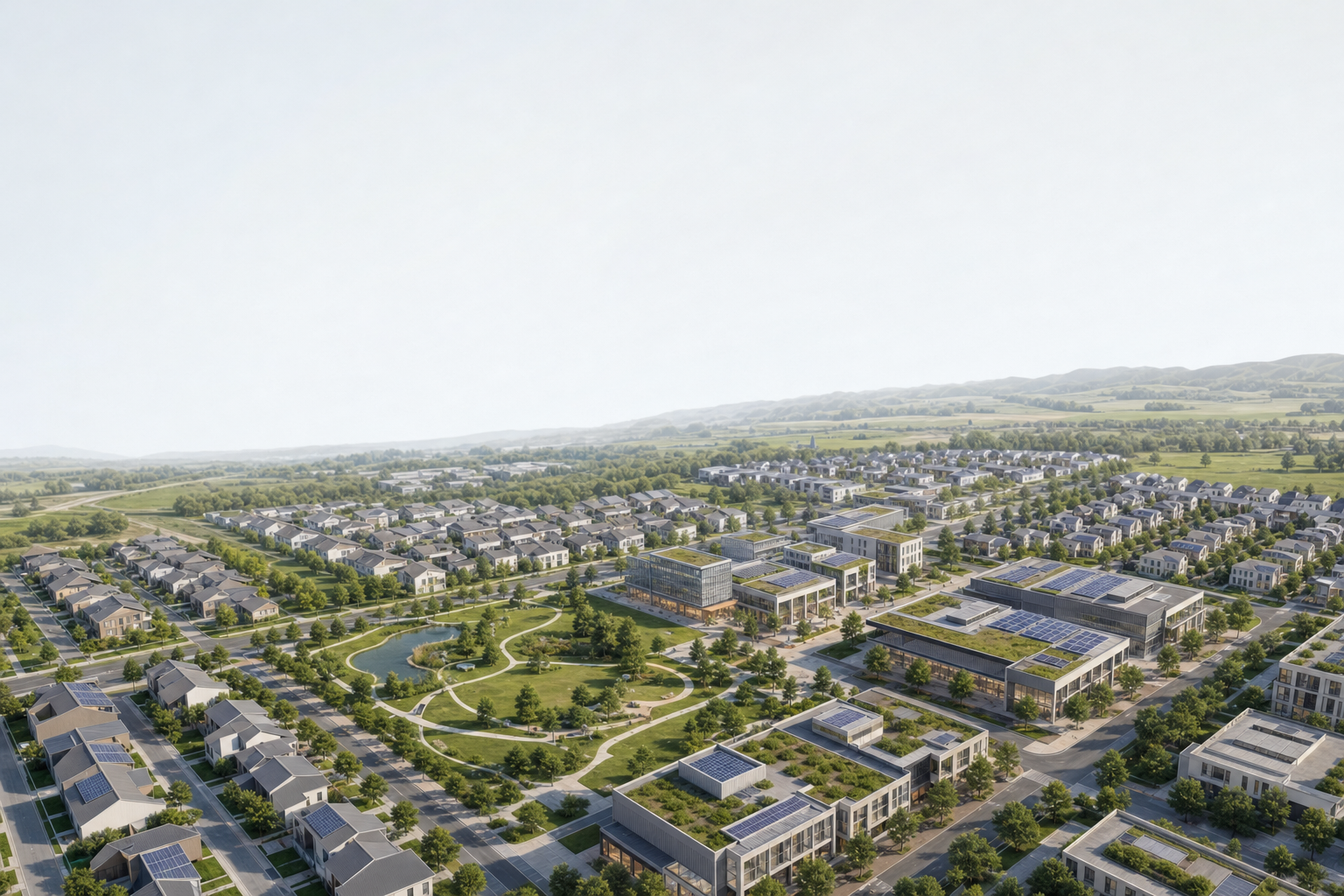
Master-planned communities: what they are and why they matter for long-term community development
Master-planned communities are often discussed in the context of residential growth, but their relevance extends well beyond housing. For business owners evaluating locations, investors assessing risk-adjusted returns, and decision-makers planning long-horizon real estate strategies, these large-scale projects are an important lens through which to understand modern community development.
At a basic level, master-planned communities are designed to coordinate land use, infrastructure, amenities, and governance under one coherent framework. That coordination can influence tenant demand, operating costs, mobility patterns, and the long-term resilience of mixed-use districts.
This article explains what a master-planned community is, how it differs from related concepts, and what practical implications it can have for commercial users and long-term-oriented investors.
What is a master-planned community?
A master-planned community is a large-scale development delivered under a comprehensive plan that integrates multiple land uses and services, often including housing, commercial areas, recreational facilities, and sometimes schools within a defined boundary. The intent is a cohesive, “from-the-ground-up” environment where daily needs can be met with less reliance on external destinations. This “self-contained” aspect is one of the defining characteristics described by FirstService Residential in its overview of the concept.
In practice, a master-planned community can function like a small city: it is planned in phases over many years, with infrastructure, placemaking, and amenities sequenced to support growth. FirstService Residential characterizes these communities as large-scale and highly amenitized environments designed with many aspects of daily life in mind, emphasizing the difference between a standard subdivision and a comprehensively designed district.
For a detailed definition and common features, see FirstService Residential’s explanation of master-planned communities.
Key characteristics relevant to community development
- Scale and phasing: Master-planned communities are typically significantly larger than conventional developments and built over long periods, allowing adaptation to market cycles and demographic shifts.
- Comprehensive planning: Land use, mobility, utilities, public realm, and amenity placement are coordinated to create a consistent framework.
- Mix of uses: Many master-planned communities integrate residential living with commercial services and recreational assets, which can support a stable daytime and evening population base.
- Governance structures: A formal governance layer is usually in place to maintain common assets and standards over time.
Related concepts: master association and planned unit development (PUD)
Because terminology varies by market, two distinctions help decision-makers evaluate structure and risk: the difference between the physical plan and the governing body, and the difference between master-planned communities and zoning tools used to deliver them.
Master-planned community vs. master association
FirstService Residential highlights that the master-planned community is the physical development: land, buildings, and amenities. The master association is the governing entity that oversees common areas, enforces rules, collects assessments, and coordinates maintenance across the broader district. Large communities may include sub-associations for individual neighborhoods or buildings under the master association umbrella.
This distinction matters in community development because governance design influences long-term asset condition, service quality, and cost predictability. More detail is available in FirstService Residential’s article.
Master-planned community vs. PUD
A planned unit development (PUD) is often a zoning designation that enables a mix of uses and flexible site design. FirstService Residential notes that the key difference is scale and scope: a PUD can be relatively small, while an MPC is typically a large, multi-phase endeavor that may incorporate multiple PUDs within its boundaries. For stakeholders, this difference helps clarify whether they are evaluating a single project entitlement or a district-level long-term framework.
Practical implications for investors, business owners, and tenants
Even when the primary narrative around master-planned communities is residential, the integrated model has direct implications for commercial occupancy, investment underwriting, and portfolio resilience.
Demand drivers: access, experience, and built-in footfall
Many master-planned communities aim to bring housing, services, and recreation into closer proximity. For tenants, that can mean access to a stable local customer base and predictable activity patterns across the week. It may also support workforce accessibility when a district includes transit planning, active mobility routes, and nearby services.
FirstService Residential also notes the increasing emphasis on amenities and “activating” them through programming. While programming is typically discussed in residential terms, the underlying principle is relevant to mixed-use environments: well-used amenities can reinforce place identity and repeat visitation, which can benefit ground-floor uses and service-oriented businesses.
Operational predictability and the role of governance
From a tenant and investor perspective, the governance model can be a source of stability or uncertainty. A master association commonly maintains shared assets and enforces standards, which can support consistent district quality over time. At the same time, it introduces a layer of rules, budgeting, and shared-cost allocation that commercial stakeholders should understand early.
FirstService Residential likens managing a master-planned community to running a small city, pointing to the operational complexity and the need for proactive financial planning, including reserve studies and long-range budgeting discipline. This is relevant to investors because deferred maintenance or underfunded reserves can create abrupt cost increases later in the life cycle.
See the discussion in FirstService Residential’s overview, including references to reserve planning and communication challenges across diverse stakeholder groups.
Phased delivery and timeline considerations
Master-planned communities are frequently delivered in phases, which affects leasing strategy, site access, and the maturity profile of the surrounding catchment area. Early-phase commercial may depend more on destination draw and convenience retail, while later phases can support broader service depth as population increases and mobility networks mature.
For investors, phasing can be positive when it supports staged capital deployment and enables design adjustments to match demand. However, it also requires careful underwriting of absorption, infrastructure sequencing, and potential disruption during construction periods.
What to review in due diligence
- Governance documents and cost allocation: Understand how common-area costs, maintenance standards, and assessments are set and updated.
- Infrastructure commitments: Review planned mobility networks, utilities, and public realm phasing to anticipate access and service levels.
- Use mix and adjacency strategy: Confirm how commercial areas are positioned relative to residential density, schools, parks, and transit routes.
- Amenity and programming strategy: Amenities can shape tenant demand; programming can determine whether amenities function as true community assets.
A long-term perspective: building resilience and value through coherent community development
From a long-term real estate viewpoint, master-planned communities are best understood as a structured approach to community development rather than a single project type. The value proposition is not simply “more amenities,” but a coordinated system: land use planning, infrastructure design, public realm, and governance working together over time.
Industry perspectives also emphasize adaptability. Nadi Group describes modern master planned communities as evolving beyond traditional subdivisions and argues that long-term value is supported by strategic planning and market adaptation, alongside future-facing considerations such as technology integration, sustainability initiatives, lifestyle evolution, and community resilience. These themes align with the idea that a district should remain functional and relevant as preferences, regulation, and mobility patterns change.
For additional context on how developers approach longevity and adaptability, see Nadi Group’s discussion of delivering exceptional master planned communities.
From an investor and occupier standpoint, the long-term question is whether the community development framework supports:
- Durable place identity: A coherent public realm and mix of uses that remains attractive across cycles.
- Efficient operations: Maintenance, renewals, and upgrades planned as part of a life-cycle approach rather than reactive spending.
- Flexibility: The ability to evolve tenant mix, mobility solutions, and amenity relevance without undermining district coherence.
Conclusion
Master-planned communities are large-scale, comprehensively planned developments that integrate multiple land uses and services within a defined area. As outlined by FirstService Residential, they are designed to function as cohesive, self-contained environments and are typically supported by governance structures such as master associations.
For business owners, investors, and decision-makers, the key considerations extend beyond design: governance quality, long-term maintenance planning, phasing strategy, and the practical performance of amenities and programming. Viewed through a community development lens, the most important attribute of master-planned communities is their capacity to align infrastructure, placemaking, and management into a framework that can deliver long-term functionality and resilience.